Is Your Brain Tired or Overstimulated? Signs Your Nervous System Needs More Than Rest

You’re tired, so you sleep in.
You take the afternoon off. Go for a walk. Put your phone down. Maybe you even manage a full weekend without opening your laptop.
And somehow, when Monday comes around, your brain still feels… full.
You can’t focus the way you usually do. Small decisions take more energy than they should. You bounce between tabs, tasks, thoughts, and conversations. You’re exhausted, but slowing down doesn’t necessarily make you feel calm.
Sometimes what feels like tiredness isn’t only about needing more sleep.
It may also be a sign that your nervous system has been processing too much, for too long.
In a place like Eugene, where it’s common to care deeply about your work, school, training, relationships, community, health, and getting outside whenever Oregon gives you the chance, a full life can quietly become a lot for your brain to manage.
You can enjoy your life and still be overloaded by it.
And you can be highly capable while your brain is asking for a different kind of recovery.
Brain Tired and Brain Overstimulated Aren’t Quite the Same Thing
There’s plenty of overlap, but it can help to notice the difference.
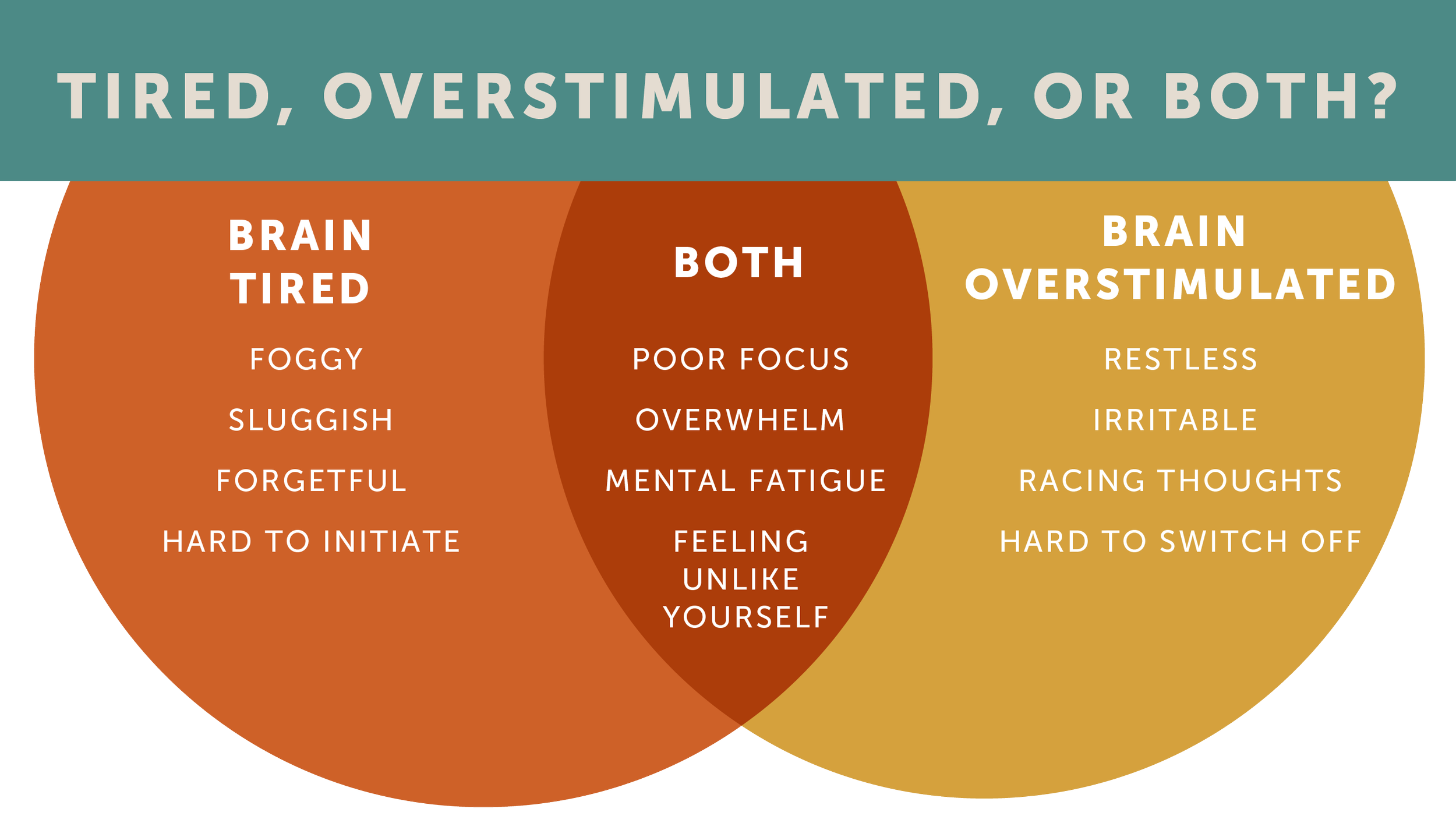
A tired brain may feel slow, foggy, forgetful, or depleted. You might have trouble getting started, finding words, organizing your thoughts, or staying engaged.
An overstimulated brain can feel almost like the opposite. Your thoughts may be moving too quickly. Every notification feels irritating. You jump from one thing to another. You want to rest, but your brain keeps scanning for the next thing that needs your attention.
And sometimes you get both at once: wired and tired.
You have very little energy, but your system still doesn’t want to switch off.
These experiences aren’t diagnoses on their own. They can overlap with stress, anxiety, ADHD, burnout, sleep difficulties, depression, physical health concerns, medication effects, and plenty of other factors.
But they can give you useful information about how much your system is carrying.
Signs Your Nervous System May Be Overloaded
Nervous-system overload doesn’t always look dramatic.
Sometimes it looks like staring at an email you know how to answer and somehow being unable to start.
Or getting home after a busy day and feeling irritated when someone asks you a completely reasonable question.
You might notice:
You have a harder time focusing, even on things you normally enjoy
You constantly switch between tasks without finishing them
Small decisions feel disproportionately exhausting
You procrastinate things that aren’t actually difficult
You feel more sensitive to noise, interruptions, crowds, or screens
You’re unusually irritable or emotionally reactive
Your mind feels busy even when your body is exhausted
You need more stimulation to stay engaged, but stimulation also wears you out
You find yourself reaching for your phone whenever there’s an empty moment
Exercise, sleep, or downtime helps temporarily but doesn’t seem to fully reset you
You’re accomplishing plenty on paper but feel increasingly scattered while doing it
For high-performing people especially, this can be confusing.
You may still be getting the work done. Showing up. Training. Parenting. Meeting deadlines. Maintaining friendships.
The outside of your life can look completely functional while the inside starts requiring more and more effort.
That doesn’t necessarily mean you need to push harder.
It may mean your brain needs help finding its way out of constant demand.
Why “Just Rest” Doesn’t Always Feel Restorative
Rest matters. Sleep matters. Taking breaks matters.
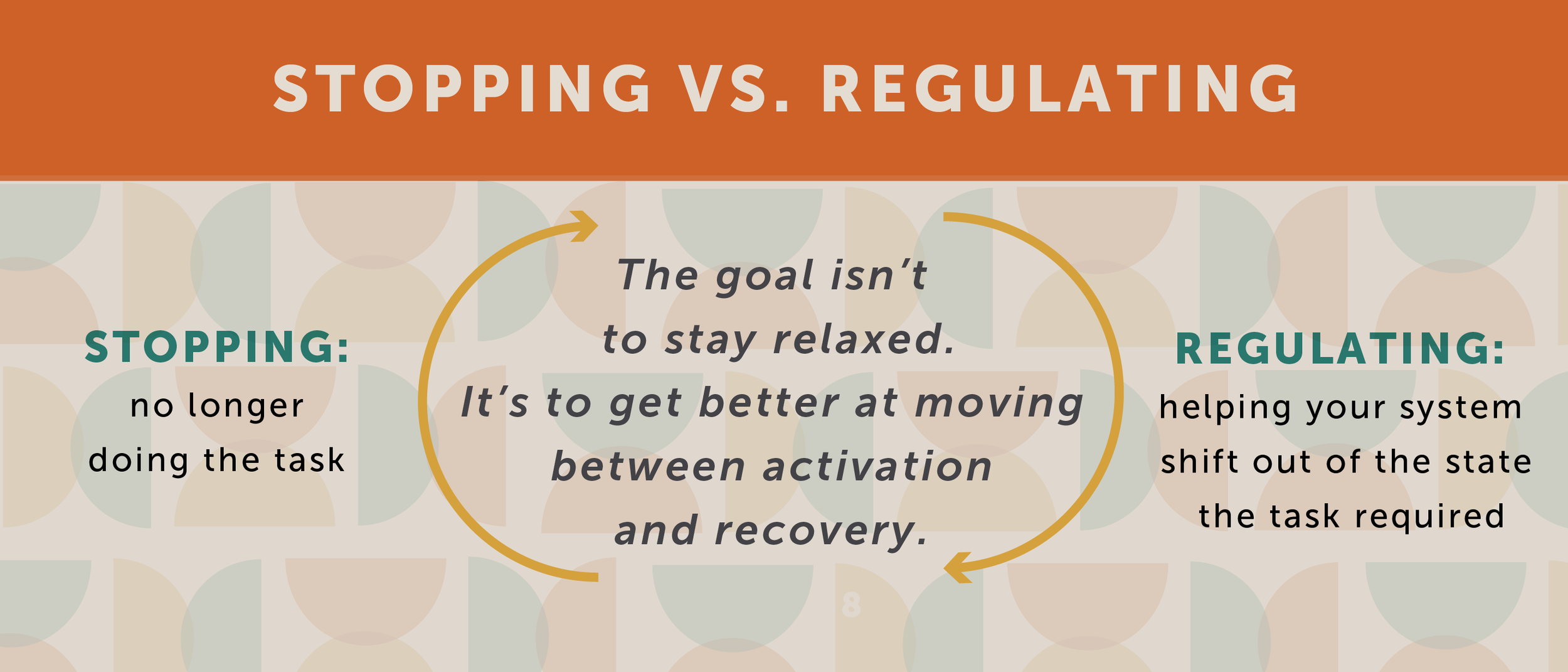
But stopping activity and feeling regulated are not always the same thing.
If you spend an entire workday responding to messages, switching between tasks, solving problems, thinking ahead, absorbing information, and managing other people’s needs, collapsing onto the couch afterward technically counts as stopping.
Your nervous system may still be running the same program.
That’s why you can lie down while mentally rehearsing tomorrow.
Go on vacation and spend the first two days unable to settle.
Finish a workout but immediately pick your phone back up.
Or take time off and feel strangely guilty because your brain has become accustomed to always having something to solve.
Sometimes recovery requires more than removing the work.
It requires giving your brain repeated opportunities to experience a different state.
Regulation Is Different From Doing Nothing
Nervous-system regulation doesn’t mean becoming calm all the time.
It means becoming more flexible.
Ideally, your system can rise to meet a deadline, competition, presentation, exam, difficult conversation, or busy afternoon — and then come back down afterward.
The problem is when the “on” position becomes the default.
A few simple changes can help create clearer transitions:
Reduce competing inputs
Try doing one thing without layering three more things on top of it.
A walk without a podcast. Lunch without scrolling. One browser window instead of fifteen. Notifications off while you finish something important.
The goal isn’t to eliminate stimulation. It’s to occasionally give your brain fewer things to sort through at once.
Give yourself an actual transition
Moving directly from eight hours of work into errands, exercise, dinner, messages, and tomorrow’s planning doesn’t leave much room for your system to register that one demand has ended.
Even ten intentional minutes between activities can help create that boundary.
Pay attention to what actually restores you
The activity that looks relaxing on paper isn’t always the one that leaves you feeling better.
Maybe it’s being outside. Moving your body. Cooking. Making something. Seeing a friend. Sitting somewhere quiet. Gardening. Reading. Doing absolutely nothing.
Notice how you feel afterward, not just whether the activity qualifies as “self-care.”
Stop treating focus like a character trait
When concentration gets harder, many people immediately make it personal.
Why am I being so lazy? Why can’t I just get this done? I used to be better at this.
Focus is affected by your environment, energy, stress level, sleep, emotional state, attention patterns, and nervous-system load.
Sometimes improving your output starts with becoming less adversarial toward the brain producing it.
When Overload Starts Affecting Your Everyday Life
There’s no perfect amount of stress a person should be able to handle.
But if brain fog, anxiety, distraction, irritability, shutdown, or difficulty focusing are consistently interfering with work, school, relationships, sleep, training, or your ability to enjoy your life, it may be worth getting some support.
You also don’t have to determine on your own whether what you’re experiencing is “really” ADHD, anxiety, burnout, stress, or something else before talking with someone.
That can be part of the conversation.
At NW Therapy Collective, we work with adults, students, professionals, athletes, parents, and other high-performing people who often describe a similar experience:
“I know I’m capable. I just don’t feel like my brain is cooperating with me right now.”
Depending on what you’re experiencing and what you want to change, support might include talk therapy, mindfulness-based approaches, practical nervous-system strategies, or neurofeedback.
Where Neurofeedback Can Fit
Neurofeedback is one option for people interested in working more directly with patterns of brain regulation.
It uses EEG technology to monitor brain activity and provide real-time feedback while you watch or listen to content. The process is non-invasive: sensors read brain activity rather than sending anything into the brain.
Over time, the goal is to give the brain opportunities to practice more flexible patterns of regulation.
At NW Therapy Collective, people may explore neurofeedback around concerns like focus, stress, emotional regulation, ADHD-related challenges, performance pressure, and feeling chronically “on.”
It isn’t a shortcut or the right solution for every person. Sometimes talk therapy is the better place to begin. Sometimes different forms of support work well together.
If you want the nuts and bolts of the process, you can read our guide to what neurofeedback looks like during your first few sessions.
And if your biggest struggle tends to happen specifically when the stakes get high, you may also find our article on why capable people sometimes freeze under pressure helpful.
You Don’t Have to Optimize Your Way Out of Everything
If you’re used to being productive, self-aware, motivated, or independent, it’s easy to approach overwhelm like one more thing to fix.
A better morning routine.
A stricter calendar.
Another supplement.
A new productivity system.
A more disciplined version of you.
Sometimes those things help.
Sometimes the more useful question is:
What is my brain actually asking for right now?
Maybe it needs fewer inputs.
Maybe it needs recovery.
Maybe it needs help working through anxiety or pressure.
Maybe you’ve spent so long functioning at a high level while overwhelmed that you no longer remember what “steady” feels like.
You don’t have to wait until everything falls apart to pay attention.
Nervous System, ADHD & Neurofeedback Support in Eugene, Oregon
If you’re feeling scattered, overstimulated, burned out, anxious, or unable to access the focus you know you’re capable of, we can help you explore what may be contributing and what kind of support makes sense.
You don’t need to choose between therapy and neurofeedback before reaching out.
Tell us a little about what you’ve been noticing, and we’ll help you clarify the next step.
